Understand what a campaign is and how to write a brief.
TL;DR
Learn what a campaign is, how it flows through Protaigé, and what makes a strong, actionable campaign brief that drives real results.
What is a Campaign?
Every great idea needs a stage. A campaign is how you put that idea into marketing motion — one clear objective, one consistent story, and a sequence of creative actions that turn attention into results. It connects your brand’s story, audience, and offer through consistent creative execution—whether that’s one targeted email or a full multi-channel rollout.

In Protaigé, campaigns are living systems. You brief once, and your AI team builds, scales, and adapts the creative across every channel — always guided by your Brand DNA.
Every campaign begins with strategy and evolves through connected stages: Brief → Concept → Hero Copy → Hero Image → Key Visuals → Assets. Each stage builds on the one before it, keeping your ideas cohesive and your creative execution grounded in purpose.
Protaigé is designed to deliver measurable outcomes at every level of marketing. It keeps global and regional teams strategically aligned while giving field marketers the freedom to generate localised, on-brand assets that reflect real market needs. From top-down planning to bottom-up activation, the system ensures every campaign moves in one direction — forward.
Campaign Scale
Not all campaigns are equal in scope. You can start small or go big—Protaigé adapts to both.
Scale | Description | Example |
Micro | A single touchpoint built around one message | A LinkedIn post announcing a product update |
Tactical | A focused push across a few channels | A webinar invitation with matching email and banners |
Integrated | A coordinated, multi-asset rollout | A full-funnel launch campaign with ads, landing page, nurture flow, and social amplification |
No matter the size, every campaign begins with a story — and in Protaigé, that story starts with your brief.
Creating a Brief in Protaigé

Every campaign begins with a clear foundation. Your brief tells the AI what you want to achieve and keeps every creative decision aligned with your brand and objectives.
Protaigé offers three pathways to create a campaign brief, giving you flexibility no matter how you like to work:
Pathway | How it works | Best for | Tutorial |
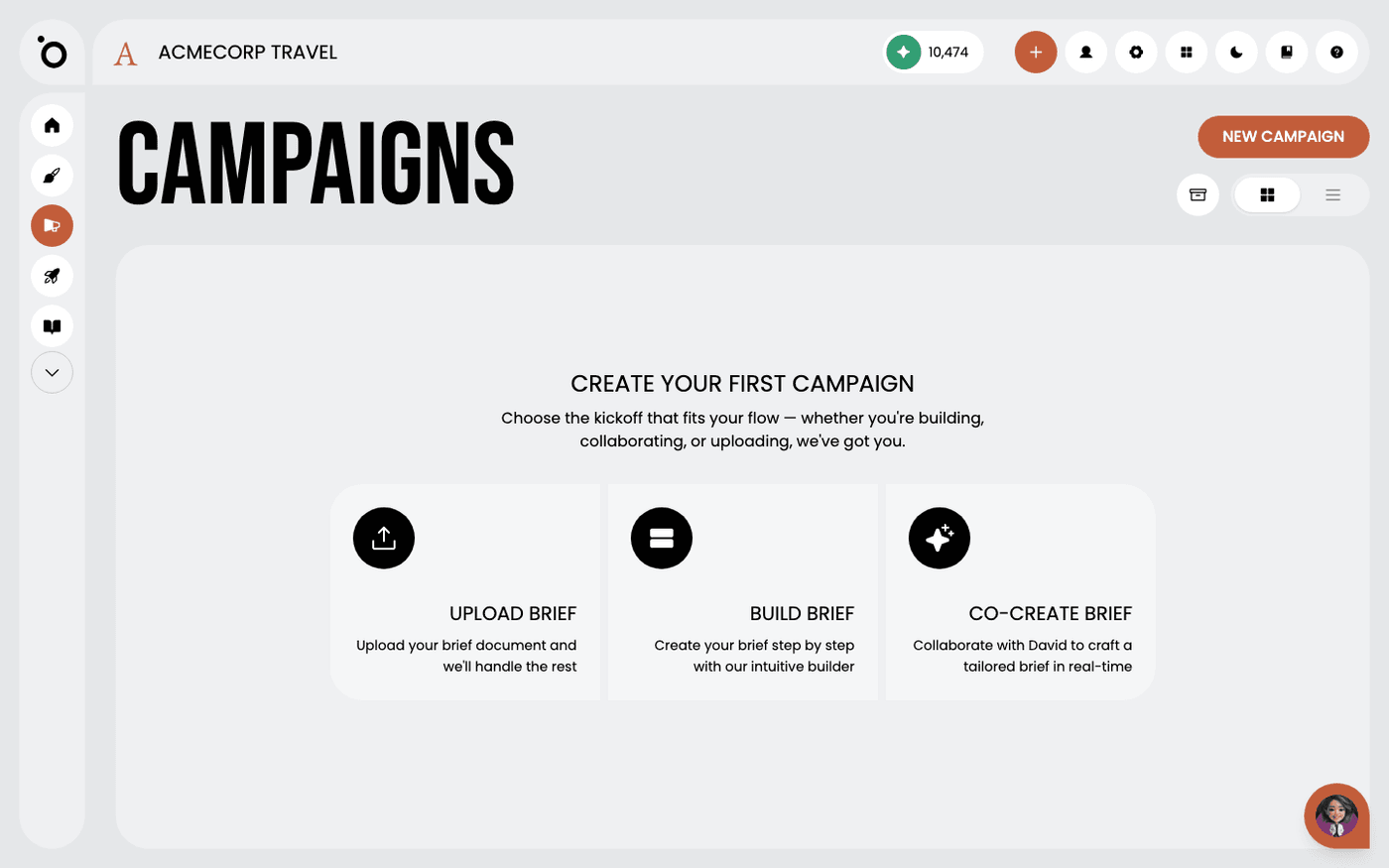
Upload a Brief | Upload an existing document or paste your text. The AI reads and analyses your content, retrieves data from your Brand DNA, and builds a complete campaign brief. | Marketers with a prepared internal brief or agency deck. | |
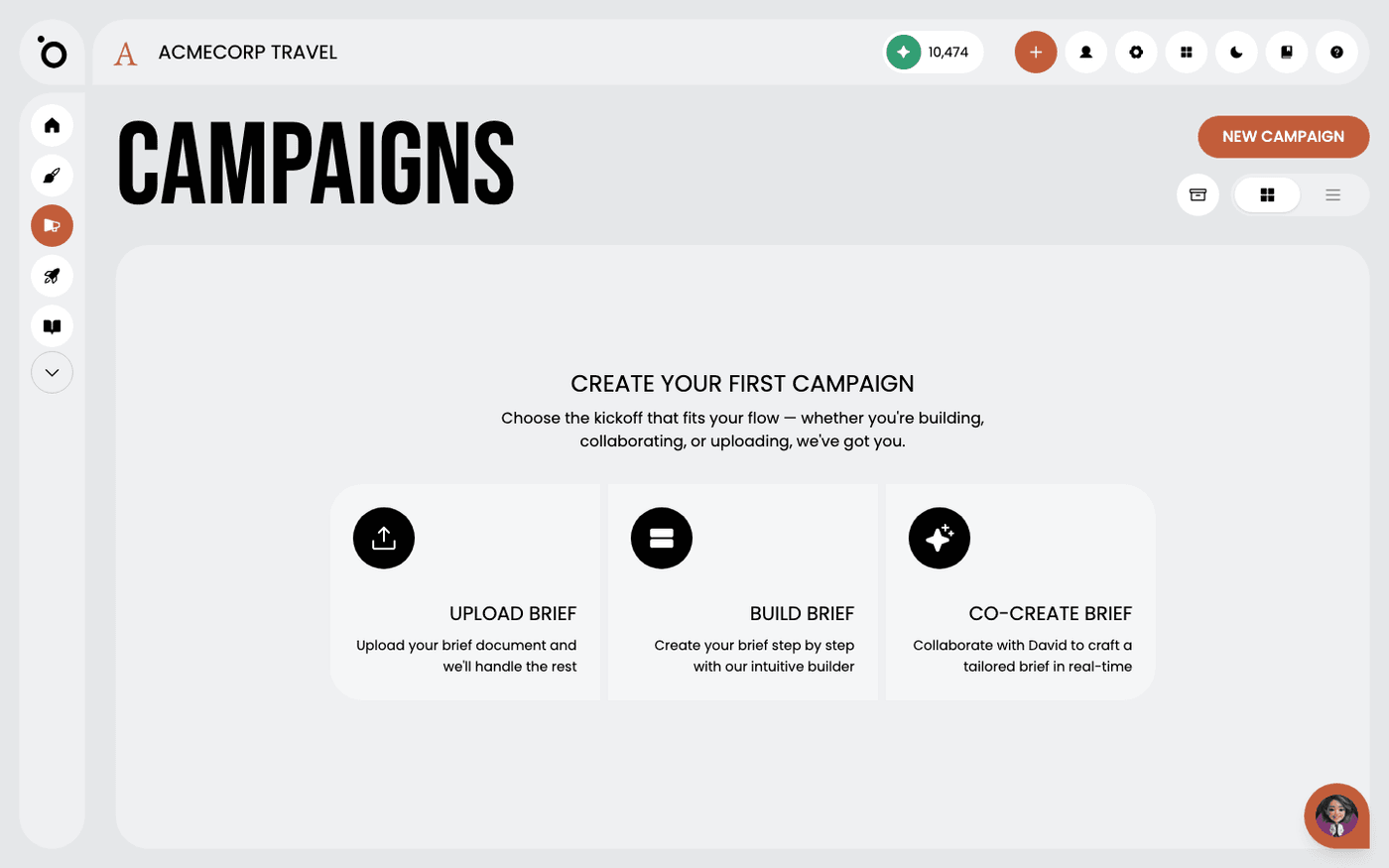
Use the Brief Builder | Fill out a guided, form-based builder with pre-filled fields drawn from your Brand DNA. Once submitted, David expands it into a complete campaign brief. | Marketers who want to build a structured brief quickly inside Protaigé. | |
3. Brainstorm with the Strategy Agent
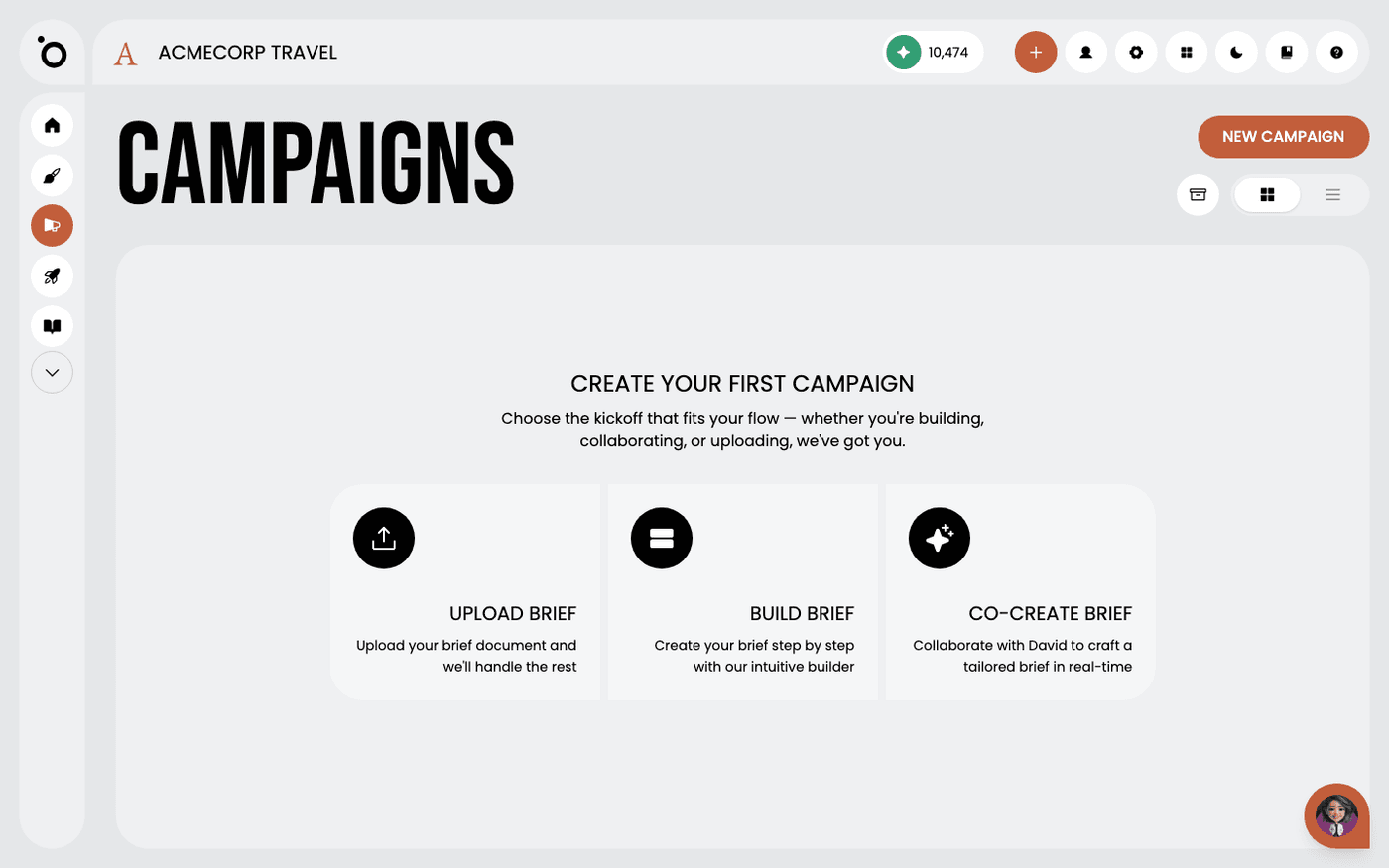
Coming Soon | Chat directly with the AI strategy agent to co-create your brief from scratch. You’ll define your goals, audience, and ideas together in real time. | Early-stage ideas or teams looking for guided, conversational planning. | Coming soon |
Whichever path you choose, your brief becomes the launchpad and the strategic backbone that fuels everything from ideas to finished assets.
Components of a Great Brief
- Define one clear goal. What does success look like?
- Choose your audience. Who do you want to move?
- Pinpoint your message. What must they understand or feel?
- Add proof. Data, testimonials, or benefits that back your claim.
- Include restrictions. Guardrails prevent off-brand or non-compliant work.
- Use consistent naming. Keep product names and personas identical to those in Brand DNA.
- Think outcomes. Every campaign should create awareness, shift perception, or drive action.
User Brief vs Protaigé Campaign Brief
When you initiate a campaign in Protaigé, you’ll see two versions of a brief — each serving a distinct purpose.
Type | What it is | Who writes it | Purpose |
User Brief | Your original input — either uploaded as a document or created through the Brief Builder. It can be any length or structure, written in your own style. | You | To outline your campaign goals, audience, and product in plain language. |
Protaigé Campaign Brief | The expanded, AI-generated version created by your strategy agent. It draws on your Brand DNA and, when needed, external research to add depth, structure, and clarity. | Protaigé | To transform your ideas into a complete, strategic campaign blueprint that guides creative development. |
Together, these two briefs form the foundation of your campaign workflow. The User Brief defines what you want to achieve. The Protaigé Campaign Brief defines how the system brings it to life strategically, consistently, and on brand.
Before You Begin
To create your first brief or campaign, a few essentials in your Brand DNA need to be complete:
- Your brand story (
Adding your brand story)
- At least one persona (
Adding persona profiles)
- At least one product (
Adding your products and services)
- At least one design kit (
Design kits 101)
These elements give Protaigé the context it needs to think, create and execute like your brand. They enable your AI agents to write in your voice, design with your identity, and tailor the campaign to your audience.
Without them, your brief has no anchor — it’s like asking an agency to build a campaign before they’ve met your brand.
Pro Tips
- Always check your Brand DNA first. If it’s current, your brief will automatically align with your tone and product details.
- Keep your objectives SMART: specific, measurable, achievable, relevant, and time bound.
- Use plain language in your uploaded or form based briefs.
- Treat the brief as your campaign’s compass. Everything else flows from here.
Glossary
Field | Definition | B2B Example | B2C Example |
Campaign name | A short, recognisable working title that captures your theme or purpose. | “Acme Automate: Scale Without Chaos” | “Glow Ahead: Summer Radiance Set” |
Objectives | The measurable goal of the campaign—what you want to achieve. | Generate 200 qualified demo bookings | Increase repeat purchases by 20% in Q3 |
Product or service | The specific offer or hero focus of the campaign. | Acme Automate workflow platform | Radiance skincare trio |
Target audience | The segment or persona you’re addressing. | Operations managers in mid-size enterprises | Women aged 25-40 interested in clean beauty |
Audience insight | A truth or motivation that shapes how you communicate. | “Ops leaders feel buried under manual processes but crave control.” | “Consumers trust natural ingredients but still want visible results.” |
Target region/ geography | The countries or markets where the campaign will run. | Singapore, Malaysia, and Australia | United Kingdom and Ireland |
Journey stage | The part of the buyer journey your campaign targets. | Consideration (driving demos and proof) | Awareness (introducing new product line) |
Key messages | The essential points you must communicate. | “Unify workflows. Reduce errors. Scale teams effortlessly.” | “Hydrated, glowing skin—powered by nature.” |
Competitive context | What alternatives your audience might consider and how you stand apart. | Competes with Asana + Zapier—offers deeper automation and native integrations | Competes with The Ordinary—positions as premium natural with dermatologist backing |
Mandatories | Elements that must appear in every output (disclaimers, legal, partner tags). | Include “Powered by Acme AI” in all banners | Include SPF rating and dermatologist quote |
Restrictions | Creative or legal boundaries to respect. | No reference to client logos without permission | No medical claims or before-and-after imagery |